
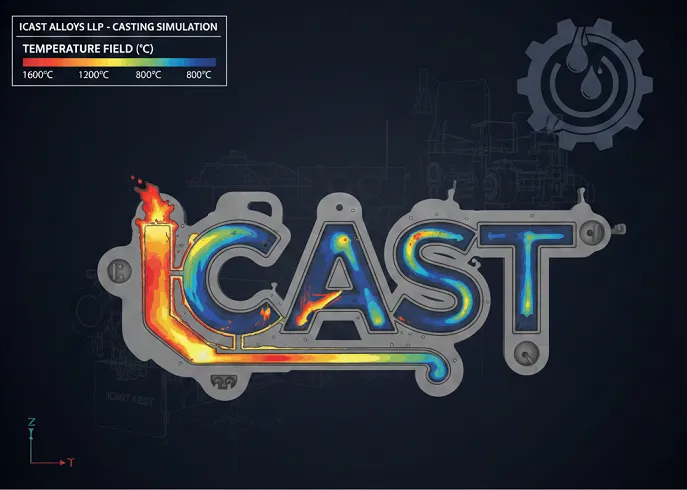
At ICAST ALLOYS LLP, we believe that excellence in casting isn't just about the final metal—it’s about the science and strategy that happens before the furnace is even lit. To ensure the highest quality components and minimize trial-and-error, we utilize advanced Casting Simulation Technology
Casting simulation is a powerful digital tool that allows our engineers to visualize and predict the entire casting process within a virtual environment. By creating a digital twin of the mold and the molten metal, we can analyze how the alloy will flow, cool, and solidify
Our engineering team at ICAST ALLOYS LLP leverages industry-leading software to analyze critical variables
At ICAST, we merge traditional craftsmanship with 21st-century technology. Our commitment to casting simulation ensures that whether you need complex industrial valves, automotive components, or bespoke engineering parts, they are delivered with mathematical precision and uncompromised quality
"We don't just cast metal; we engineer reliability."
Predicts turbulence, air entrapment, and temperature loss during the pour.
Predicts turbulence, air entrapment, and temperature loss during the pour.
Identifies "hot spots" and calculates shrinkage to ensure structural density
Identifies "hot spots" and calculates shrinkage to ensure structural density
Monitors the cooling rates of the die and the casting to prevent warping or stress cracks
Monitors the cooling rates of the die and the casting to prevent warping or stress cracks
Digitally refines the path the metal takes to ensure smooth, laminar flow
Digitally refines the path the metal takes to ensure smooth, laminar flow.
